
LIFE SCIENCES
Clinical data integration creates a trusted, near real-time data environment
Connecting fragmented clinical data through governed integration, automated reconciliation, and human validation to deliver trusted, study-ready data in real time.

Client
Leading glucose management and diabetes care company
Goal
To consolidate clinical data across systems while improving traceability, governance, and the speed at which study-ready data becomes available
Tools and Technologies
Databricks, AWS Kinesis, Apache Spark
Business Challenge
Clinical study information was distributed across multiple applications, including regulatory document management systems and clinical trial management system platforms. With no common identifier linking records across these systems, consolidating and reconciling clinical data was a complex process.
The client needed to bring structured and unstructured data together at scale while maintaining the traceability and governance required for clinical research.
Manual reconciliation across systems was also time-consuming and prone to errors. As a result, study-ready data could take several days to become available, limiting the speed at which teams could access and act on critical information.

Solution
- Iris designed and implemented a Databricks-based data platform on AWS to integrate clinical data from multiple systems into a centralized and governed environment.
- A metadata-driven ingestion framework using a Bronze-Silver-Gold architecture was established to streamline the onboarding of new data sources while maintaining consistent data lineage.
- Iris also built a reconciliation and matching engine that generated ranked, explainable candidate matches across disparate systems. Human-in-the-loop workflows enabled users to review, validate, and approve matched records, providing an additional layer of control and accuracy.
- Enabled secure sharing of approved study, site, and regulatory data through Databricks and Delta Sharing.

Outcomes
The solution helped the client establish a more connected and responsive clinical data environment. Key outcomes included:
- Created a single trusted view of clinical data across multiple systems.
- Reduced data availability time from 3–5 days to near real-time, improving operational responsiveness.
- Reduced manual reconciliation efforts through automated, auditable matching and approval workflows.
- Approved study, site, and regulatory data was then made available to client environments through Delta Sharing, enabling secure, zero-copy data exchange.

Our experts can help you find the right solutions to meet your needs.
Explore the world with Iris. Follow us on social media today.
Clinical intelligence platform strengthens data-driven clinical research


LIFE SCIENCES
Clinical intelligence platform strengthens data-driven clinical research
Unifying fragmented clinical data through scalable ingestion and human-in-the-loop validation to enable trusted insights and faster AI-driven decision-making.
Client
Leading provider of clinical trial reviews, research, compliance services
Goal
To unify fragmented clinical trial data and create a scalable foundation for timely, trusted insights and AI-driven decision-making
Tools and Technologies
Databricks, AWS Kinesis, Apache Spark
Business Challenge
Clinical trial information was distributed across multiple systems and data sources, making it difficult to integrate, interpret, and use the information effectively.
The data included unstructured content such as protocols, administrative correspondence, schedules, and supporting documents, along with structured data from IRB systems, CTMS platforms, and operational databases.
This fragmented data landscape limited the ability to generate timely insights, streamline workflows, and scale AI-driven decision-making across clinical research operations.
Solution
- Iris analyzed the requirements and developed a scalable intelligence platform to bring disparate clinical trial data together and transform it into trusted, actionable information.
- The solution included robust data ingestion pipelines capable of processing more than 80,000 protocol documents at scale and converting unstructured content into high-quality structured data. This established a reliable data foundation for AI/ML models and supported the expansion of the platform's knowledge base.
- We also built human-in-the-loop (HITL) validation workflows to enable human review and oversight of AI-generated outputs. The workflows helped refine results while strengthening governance, compliance, and quality controls required for clinical research.
Outcomes
The platform created a reliable data backbone for clinical research and helped the client make better use of its growing data landscape. Key outcomes included:
- Accelerated AI-driven insights through a reliable and structured data foundation
- Reduced manual effort involved in data preparation
- Faster onboarding of new data sources
- Improved accuracy and trust in AI-generated insights
- Strengthened compliance and quality controls for clinical research use cases
Our experts can help you find the right solutions to meet your needs.
Explore the world with Iris. Follow us on social media today.
Knowledge-assisted engineering platform accelerates developer productivity


LIFE SCIENCES
Knowledge-assisted engineering platform accelerates developer productivity
Connecting code, data lineage, dependencies, and business knowledge to simplify troubleshooting and accelerate ticket resolution and change implementation.
Client
Leading glucose management and diabetes care company
Goal
To improve developer productivity by simplifying access to technical and business knowledge and accelerating troubleshooting and change implementation.
Tools and Technologies
Claude, Graphify, Confluence, Jira
Business Challenge
The client's data platform consisted of numerous ETL pipelines, database repositories, and codebases, making it difficult for developers to understand dependencies and trace data flows across the environment.
Developers spent significant time investigating failures, tracing dependencies, understanding the potential impact of changes, and working through change requests. This was further complicated by business knowledge, technical documentation, and code repositories being maintained in separate silos.
The lack of a unified view made impact analysis and troubleshooting more difficult and increased the time required to resolve tickets and implement changes.
Solution
- Iris built a unified knowledge platform that brought together code lineage, dependency mapping, and business documentation to give developers relevant context in one place.
- The platform used Graphify to map code lineage and dependencies and Confluence to bring in business and technical documentation. Developers could use Jira tickets as inputs to retrieve relevant context, understand potential impact, and access recommended resolutions from these knowledge sources.
- By surfacing dependencies, data lineage, and implementation guidance, the solution reduced the need for manual investigation. Context-aware engineering workflows also helped developers move more quickly from identifying an issue to determining the appropriate resolution.
Outcomes
The solution helped streamline engineering workflows and reduce the time spent investigating and resolving development issues. Key outcomes included:
- Reduced ticket resolution and change implementation timelines from days to hours
- Improved developer productivity through faster access to dependency and data lineage information
- Simplified impact analysis and troubleshooting by bringing technical and business knowledge together
- Accelerated bug resolution and change delivery through context-aware engineering workflows.
Our experts can help you find the right solutions to meet your needs.
Explore the world with Iris. Follow us on social media today.
Product engineering strengthens clinical trial management platform


LIFE SCIENCES
Product engineering strengthens clinical trial management platform
Advancing a clinical trial management platform through product engineering, API modernization, and continuous improvements to scalability, security, and performance.
Client
Leading provider of clinical trial reviews, research, compliance services
Goal
To strengthen the CTMS platform through continuous product engineering, modernization, and technology improvements.
Tools and Technologies
AWS Lake Formation, Java, PostgreSQL
Business Challenge
The client's Clinical Trial Management System (CTMS) supports clinical studies across the research lifecycle, from study setup through closeout. The platform also helps streamline clinical trial operations, improve billing compliance, and provide actionable reporting and analytics.
As the product continued to evolve, the client needed to enhance its core capabilities while maintaining the scalability, performance, security, and reliability required to support growing clinical research needs.
The platform also required modernization of its integrations and continued development of business-critical capabilities to improve interoperability and support future growth.
Solution
- Iris acted as a strategic product engineering partner, supporting the evolution of the CTMS platform and its long-term product roadmap.
- The team owned end-to-end delivery of business-critical features, covering requirements analysis, solution design, development, testing, and release. Iris also drove continuous product and technology improvements to enhance platform scalability, performance, security, and maintainability.
- As part of the modernization efforts, Iris enhanced APIs and integrations to improve interoperability and prepare the platform for future growth. The team worked closely with product management and business stakeholders to translate customer needs into relevant product capabilities.
- Iris contributed across key functional areas, including Protocol Creation, Clinical Trial Calendars, and Payments & Financial Management.
Outcomes
The product engineering engagement helped strengthen the CTMS platform across accessibility, integration, security, and reliability. Key outcomes included:
- Achieved WCAG 2.0 compliance for the client's research portal, improving accessibility and user experience
- Modernized payment integrations by migrating from SOAP to REST APIs, improving interoperability and scalability
- Strengthened product security and reliability through proactive vulnerability remediation and critical security enhancements
Our experts can help you find the right solutions to meet your needs.
Explore the world with Iris. Follow us on social media today.

The AI & Digital Roadmap for Mutual Carriers
Modernize infrastructure, automate operations, and adopt AI in phases, without replacing the core systems that run your insurance business.

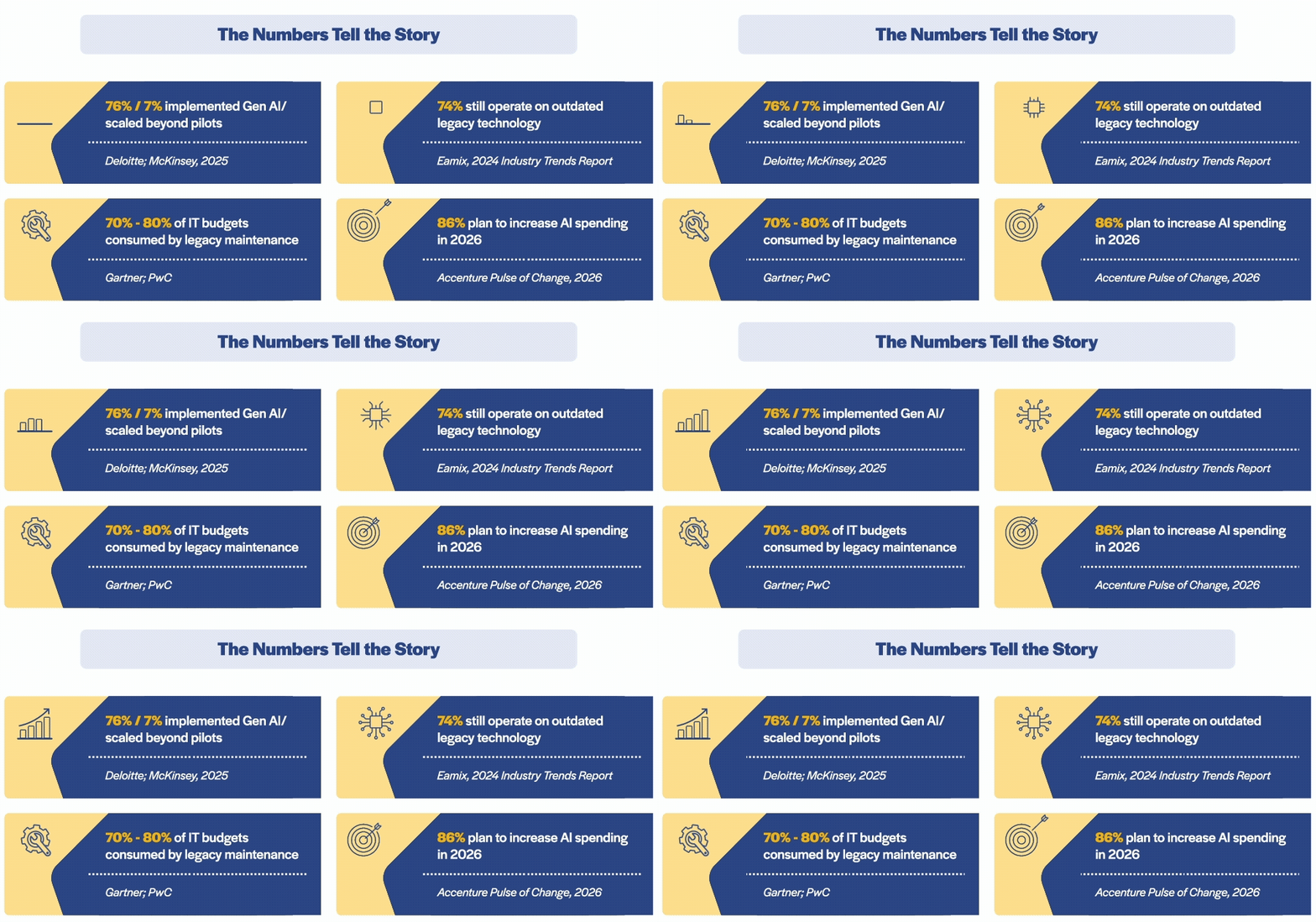
Mutual carriers are built on strong governance, member relationships, and operational discipline. But legacy technology, fragmented data, lean IT teams, and rising expectations are making it harder to respond with the speed and insight required today.
Modernization does not have to mean replacing the systems that already support the business. A phased approach can build digital capabilities around the existing technology landscape, creating value at every stage while establishing the foundation for AI adoption.
Four Phases to Build a More Intelligent Operating Model
- Connect - Create the data and integration foundation by connecting policy, claims, billing, and other core systems through APIs. This reduces manual workarounds and enables information to flow across the organization.
- Automate - Orchestrate workflows across connected systems to automate repetitive processes such as claims intake, document processing, and new business processing. Auditable workflow automation reduces administrative effort while improving consistency and speed.
- Augment - Introduce Generative AI to support employees with capabilities such as document summarization, claims triage, underwriting support, and customer communication. Human oversight remains central, with AI handling information-intensive tasks while employees retain decision authority.
- Elevate - Turn operational data into real-time business intelligence through analytics, dashboards, and reporting. Leadership gains greater visibility into claims performance, underwriting, customer experience, operational resilience, and other business-critical metrics.
Modernization Without a Big-bang Replacement
The roadmap demonstrates that core system replacement is not a prerequisite for digital or AI transformation. By connecting existing infrastructure, building workflow layers, and progressively introducing automation, AI, and analytics, mutual carriers can modernize at a manageable pace while preserving the systems and institutional knowledge that underpin the business.
The result is an operating model that is more connected, efficient, intelligent, and scalable—while remaining governed and aligned with the realities of the insurance business.
From Technology Investment to Strategic Advantage
For mutual carriers, modernization is not simply about adopting new technology. It is about creating a digital foundation to respond faster to market demands, strengthen operational resilience, improve employee productivity, and make better-informed decisions.
Learn how a deliberate, phased roadmap enables carriers to move from fragmented systems and manual processes toward AI-enabled operations that build capabilities today that can support long-term competitive advantage.
Iris Sponsors Mutual Insurance Convention

Iris Sponsors Mutual Insurance Convention
Join our InsurTech and insurance industry leaders at the 2026 Mid-Atlantic Mutual Advantage Convention to examine the latest AI, regulatory, risk, and market trends.
Iris Software is pleased to be a bronze sponsor of the 119th Mid-Atlantic Mutual Advantage Convention (MAMAC), occurring August 2 - 4, 2026, at the Gaylord National Harbor Resort and Convention Center in Maryland. The Convention is hosted by the Pennsylvania Association of Mutual Insurance Companies, of which Iris Software is a marketplace provider member, in partnership with the mutual organizations of Virginia, West Virginia and Maryland. The theme of this year’s event, which several hundred insurance industry leaders are expected to attend, is See Beyond, Rise Above.
Discussion points noted on the Convention agenda are strategic insights, growth and capital, state challenges, federal and regulatory updates, and the rapidly evolving AI risk landscape. AI topics also may include silent AI exposures, explicit AI exclusions, affirmative coverages in the marketplace, as well as AI risk examples and industry trends.
Iris delivers advanced technology services and solutions to leading insurers, in the property, casualty, specialty, life, annuity and other sectors, that provide measurable positive outcomes in key business areas. Venkat Laksh, Head of Insurance IT Sales, and Abhineet Jha, Head of Insurance IT Services, are attending MAMAC to share our client success stories and the value derived from our advanced AI-powered capabilities, domain expertise, and collaborative, client-centric approach. Outcomes have included enhanced broker, agent, and policyholder experiences; increased speed-to-market and market share; assured cloud, compliance, cybersecurity; integration without disruption; clean, connected, AI-ready data; advanced analytics that drive business decisions; and Agentic AI workflows built to scale.
Learn from Venkat and Abhineet how partnering with Iris and applying our solutions in Agentic and Generative AI, Application Engineering, Intelligent Automation, Modernization, Cloud and Data Engineering, can advance the digital transformation and strategic growth goals of your insurance enterprise.
You also can contact our InsurTech team, including client partners Parijat Sharma, Vaibhav Brajesh, Sreedhar Angam, and delivery partner Mayank Khanna, to discuss your technology objectives.
Learn more about our Insurance Technology Services, use cases and Generative AI Experience.
Reboot Magazine Highlights Iris for AI Logistics Innovation
Reboot Magazine Highlights Iris for AI Logistics Innovation
Iris Software and Odyssey Logistics are featured for co-developing SpotBot, an AI-driven platform revolutionizing supply chain logistics.
Iris Software has been featured in Reboot Magazine in a story showcasing Odyssey Logistics and entitled, “Orchestrating the Future of Global Logistics.” The article, in the April 2026 edition, highlights the companies’ jointly developed SpotBot solution that is transforming supply chain logistics using AI-powered automation, real-time data and insights, and intelligent decision-making.
Read the full Reboot Magazine feature here.
At the core of this story is SpotBot, a platform co-engineered by Iris and Odyssey. Designed to improve operations throughout complex logistics ecosystems, SpotBot integrates multiple intelligent components. It leverages artificial intelligence, automation, decision models and data such as historical shipments and prices, market trends, carrier capacity signals, and load-to-truck ratios, enabling real-time price validation, accelerated bidding processes, and enhanced visibility and coordination across the supply chain. The platform enables organizations to respond faster and more precisely to dynamic market conditions, including optimizing shipment timing for improved cost efficiency.
Mahesh Kesarkar, Head of Manufacturing and Logistics at Iris Software, noted that the successful SpotBot collaboration reflects the impact of combining deep domain expertise and purposeful digital innovation with an aligned vision. SpotBot also demonstrates how advanced technology, such as its cloud-native architecture designed for scalability, flexibility, and seamless enterprise integration, can reshape logistics outcomes and the future of global supply chains.
Iris Software provides advanced technology solutions across AI, Gen AI, Application Engineering, Automation, Cloud, and Data & Analytics to leading logistics, supply chain and manufacturing organizations, helping them to modernize operations and drive digital transformation and business growth. Learn more about our logistics and supply chain services.
Future ready enterprise payment management system


Consolidating and standardizing digital payment services to one configurable system lowers costs, enhances service, and enables future e-commerce platform integrations.
Client
An educational testing and assessment organization
Goal
To streamline external gateway and acquirer services into a single system to reduce costs, boost service and enable wider payments and e-commerce integration
Tools and Technologies
Angular JS, PeopleSoft T&L, Vertex Tax Cloud, Chase Payment Tech, PayPal, PostgreSQL
Business Challenge
The client needed to standardize all credit card and e-payment processes by replacing custom-developed and externally hosted gateways with a merchant-configurable system. The aim was to consolidate gateway and acquirer services under a single vendor to reduce costs, improve service levels, and enable future integration with SaaS or open-source e-commerce solutions.
Solution
- Created a centralized set of payment collection and processing pages for all e-commerce applications
- Ensured PCI compliance at an enterprise level
- Integrated and streamlined system reconciliation processes
- Implemented robust logging, error handling, and real-time status updates for transactions
- Deployed a post back system to capture responses, validate outcomes, update registration statuses, and send error reports via email
- Designed the system for future integration with SaaS or open-source e-commerce platforms
Outcomes
- Reduced costs by eliminating external payment gateway hosting and development fees
- Delivered updated and user-friendly validation messages
- Enabled future API development for a fully functional service/connection
Our experts can help you find the right solutions to meet your needs.
Explore the world with Iris. Follow us on social media today.
Facilitating data-driven analytics and decision support


Creating a Data Lakehouse as a single source of truth with a multi-year strategy to derive insights, identify gaps, and enable fact-based decisions.
Client
An educational testing and assessment organization
Goal
To create a single data source that gives market insights, identifies gaps and facilitates a multi-year data-driven strategy
Tools and Technologies
Redshift, AWS Glue, AWS Kinesis, Apache Spark, AWS Athena, AWS Lake Formation
Business Challenge
The client managed vast amounts of data from multiple sources to extract market insights However, duplication across approximately 300 applications hampered analytics and adaptability. The goal was to eliminate duplication, identify gaps, and create a single source of data that could be leveraged for efficient, data-driven decision-making.
Solution
- Built a centralized Data Lake and Data Lakehouse as the single source of data
- Facilitated seamless data ingestion
- Created a single version of data and DataOps processes
- Streamlined governance through retirement of duplicate and mirrored databases
- Outlined a multi-year data strategy with clear foundational steps for scalability
Outcomes
- Enabled analysis and advanced analytics using a centralized data lake
- Transformed decision making into a data-driven process
Our experts can help you find the right solutions to meet your needs.
Explore the world with Iris. Follow us on social media today.
Migrating multiple databases to one streamlined source


Developing an architecture for data migration from several databases to a single, streamlined source with automated workflows, improved data analytics, execution of complex business rules, and cost savings.
Client
Major educational testing and assessment organization
Goal
Enable data migration from multiple sources to a streamlined source with automated workflows and improved data analytics
Tools and Technologies
AWS Glue, Redshift, Power BI, Oracle, MS SQL Server, MS SharePoint
Business Challenge
The client used a limited number of applications to source data from multiple types of databases. The outdated system slowed responses to critical requests. It also faced challenges in executing complex business rules. Owing to the lack of a centralized data warehouse, its data analytics could not deliver meaningful insights. Maintenance costs were also high.
The goal was to streamline the number of data sources, create a single store for data analytics, and reduce overall costs.
Solution
- Developed a customizable ETL architecture to pull data from any type of data source
- Created fully automated workflows using AWS Glue to transfer data between Stage, ODS and DWH instances
- Built a single source of information for data analytics
- Developed data analytics dashboards in Power BI
- Enabled system to perform complex business rules on the fly by integrating AWS Glue with stored procedures
Outcomes
- Optimized and consolidated multiple servers into three or fewer
- Reduced risk involved in maintenance of unsupported and dated database servers
- Improved data processing and data transfer by automating workflows
- Enhanced quality by using a single source of information for data analytics and applications
Our experts can help you find the right solutions to meet your needs.
Explore the world with Iris. Follow us on social media today.