
Celebrating 35 Years of Iris icon Explore the Journey

×
Evolution of Hybrid DLT Architecture

The Evolution of Hybrid DLT: From Permissioned Ledgers to Public Networks

Discover how hybrid distributed ledger architecture enables financial institutions to balance privacy, compliance, interoperability, and liquidity by combining the strengths of permissioned and public blockchain networks.

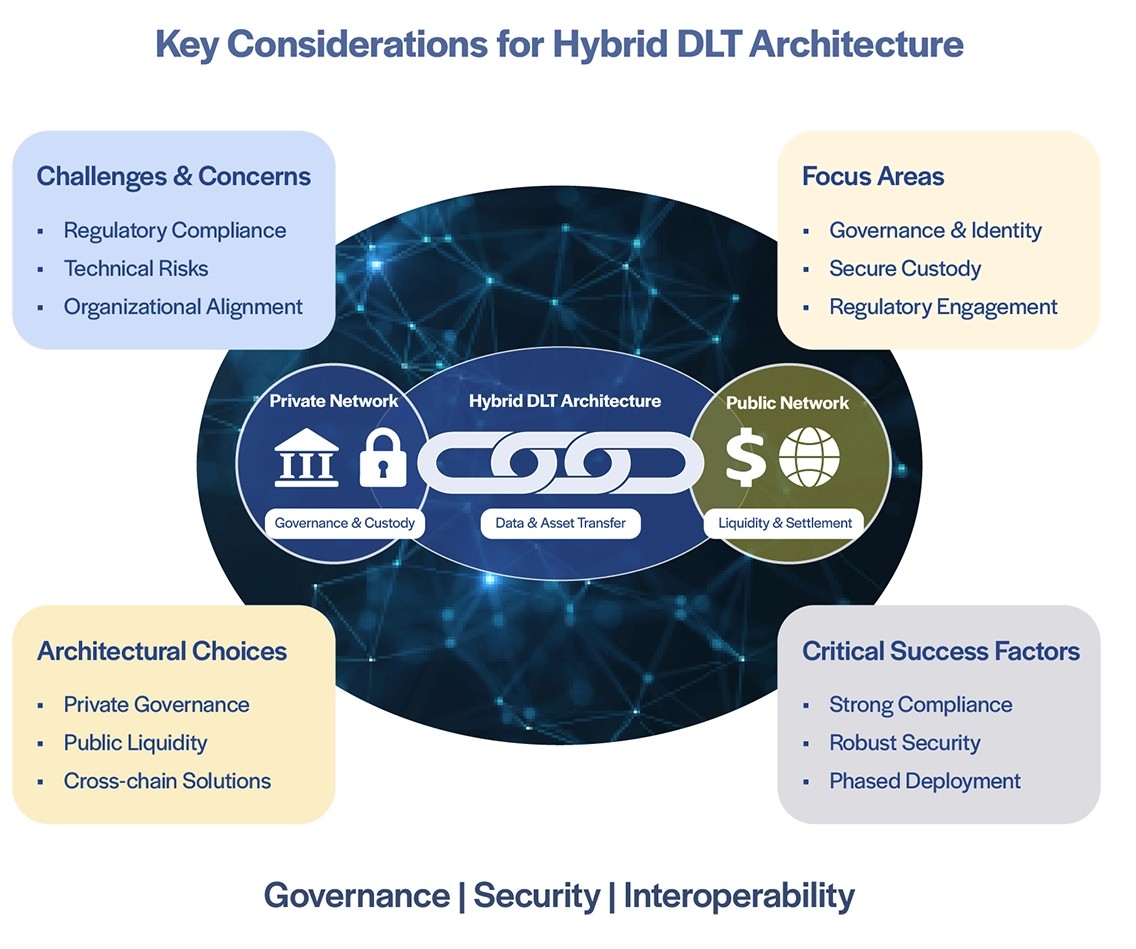
    Financial institutions are accelerating their digital asset and blockchain initiatives but choosing between public and private distributed ledger technologies (DLTs) remains a significant challenge. While public networks offer transparency, interoperability, and access to global liquidity, they often fall short of institutional requirements for privacy, governance, and regulatory compliance. Permissioned DLTs address these concerns but can limit interoperability and market reach.

    Hybrid DLT architecture is emerging as the next stage in distributed ledger evolution by combining the strengths of both models. Sensitive business processes, governance, and regulatory controls remain within permissioned environments, while public blockchain networks enable secure settlement, broader market access, tokenized asset distribution, and programmable financial services. This approach allows organizations to unlock innovation without compromising security or compliance.

    Successfully implementing a hybrid architecture requires more than connecting two networks. Organizations must carefully address governance, identity management, interoperability, cross-chain communication, custody, regulatory alignment, cybersecurity, and enterprise integration. Architectural decisions around asset lifecycle management, smart contracts, cross-chain bridges, and compliance frameworks play a critical role in ensuring secure and scalable deployments.

    Leading financial institutions are already demonstrating how hybrid DLT can support tokenized assets, improve operational efficiency, expand liquidity, and bridge traditional finance with decentralized finance. As regulatory frameworks continue to mature, hybrid architectures are expected to become the preferred foundation for enterprise blockchain adoption.

    Read our perspective paper to explore the evolution of hybrid DLT, understand the key architectural considerations for successful implementation, and learn how financial institutions can build secure, compliant, and future-ready digital asset ecosystems.

    Download Perspective Paper


      Contact

      Our experts can help you find the right solutions to meet your needs.

      Get in touch
      Agentic AI Framework Operational Risk Commercial Corporate Banking

      Agentic AI Reduces Risk in Commercial Banking

      Strengthen operational resilience by embedding AI-driven intelligence, governance, and human oversight into commercial and corporate banking workflows.


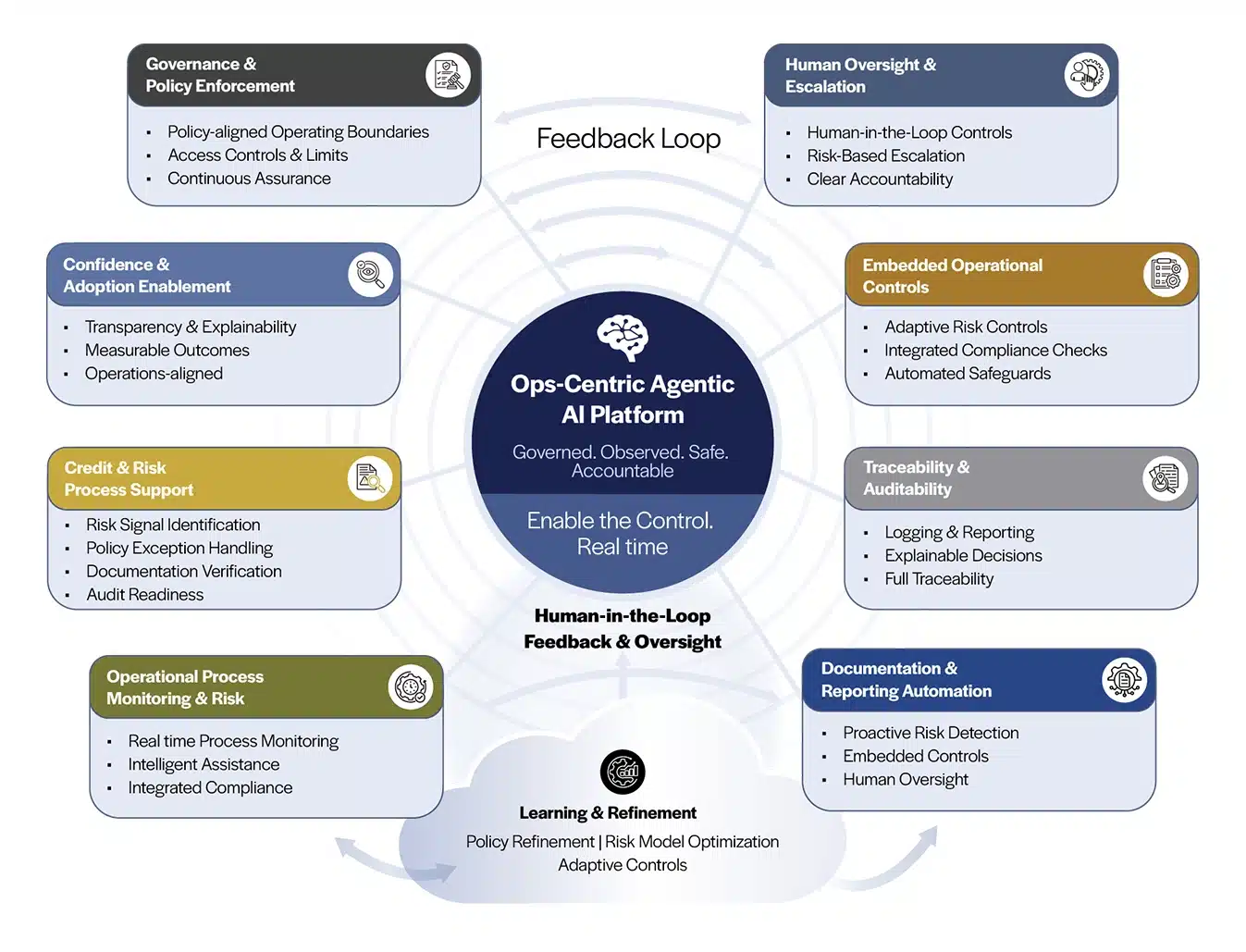
        An Agentic AI framework introduces intelligent AI agents that continuously monitor operational workflows, detect anomalies, recommend policy-aligned actions, and support decision-making within clearly defined governance boundaries. By combining contextual intelligence with human oversight, banks can improve operational efficiency, strengthen risk management, and maintain transparency, accountability, and regulatory confidence.

        The framework also enables organizations to capture and institutionalize expert knowledge through a Human-in-the-Loop (HITL) approach. As business and risk professionals review exceptions, interpret policies, and make critical decisions, the platform continuously learns from these interactions. This evolving decision intelligence improves the accuracy, consistency, and policy alignment of future recommendations while ensuring that high-impact decisions remain under human oversight.

        From operational process monitoring and credit risk support to documentation automation and loan servicing, Agentic AI enables commercial and corporate banks to embed intelligence directly into operational workflows. The result is faster decision-making, improved compliance, enhanced operational efficiency, and greater organizational resilience.

        Read our perspective paper to discover how an Agentic AI framework helps commercial and corporate banks transition from reactive operational risk management to proactive, AI-powered operational intelligence.

        Download Perspective Paper


          Contact

          Our experts can help you find the right solutions to meet your needs.

          Get in touch

          Reuters – The Future of Insurance 2026

          Reuters – The Future of Insurance 2026

          Reuters – The Future of Insurance

          Connect with Venkat Laksh, our Head of Insurance IT Sales, at the 2026 FOI forum to learn how insurers are fusing advanced, AI-driven technologies and other enterprise growth areas.

          Reuters Events hosts this year’s Future of Insurance (FOI) forum on June 25-26, 2026, at the Marriott Marquis Hotel in Chicago, Illinois. FOI is a premier North American industry event where more than 500 insurance leaders come together to discuss and align key topic areas of technology, products, customers and risk. The primary themes of this year’s FOI sessions are turning strategy into growth, building the digital backbone, elevating customer experience, and ensuring risk readiness.

          Iris provides Insurtech services to leading insurers, in property, casualty, specialty, life and annuity, and other sectors, that result in measurable positive outcomes in these areas. Venkat Laksh, our Head of Insurance IT Sales, is attending FOI 2026 to share Iris client success stories and the value derived from our advanced AI-powered capabilities, domain expertise, and collaborative, client-centric approach. Learn from Venkat how partnering with Iris and applying our solutions in Agentic and Generative AI/ML, Application Engineering and Modernization, Cloud and Data Engineering, can advance the digital transformation and strategic growth goals of your enterprise.

          You also can contact our InsurTech team, including Abhineet Jha, Head of Insurance IT Services, and Client Partners Glenn DeGeorge, Parijat Sharma, and Vaibhav Brajesh and Delivery Partner, Mayank Khanna, to discuss your technology objectives.

          Learn more about our Insurance Technology Services and Generative AI Experience.

          Contact

          Our experts can help you find the right solutions to meet your needs.

          Get in touch

          Unified platform automates investment deal data

          INSURANCE

          Unified platform automates investment deal data

          Self-service web portal built with API integration replaces legacy SharePoint system, delivers improved UX, cost-efficiency, and real-time reporting for teams managing deals and issuer data.

          Client
          Large NY-based insurance and investment company
          Goal
          Develop a modern, scalable system to manage deal and issuer data efficiently while eliminating legacy costs and inefficiencies
          Tools and Technologies
          .Net Core 6(API) , Background Service, Angular 14, SQL Server
          Business Challenge

          The client’s SharePoint-based system for managing deal and issuer details faced major limitations. As data volume and user count increased, the platform became slow, difficult to customize, and expensive to maintain. Integration with other critical tools was limited, reducing efficiency and scalability. These constraints created risks to effective deal management and hindered the ability to scale operations.

          Solution
          • Built a modern web-based system using Angular (front-end), .NET Core (back-end), and SQL Server (data storage)
          • Developed a self-service portal for internal teams to easily manage deal and issuer data
          • Automated data ingestion, cleaning, and storage with a background service for accuracy and consistency
          • Integrated Splunk and Application Insights to enable real-time monitoring of system health and performance
          Outcomes
          • Substantial cost savings by eliminating SharePoint licensing and maintenance expenses
          • Improved performance and scalability with faster system response and ability to support more users
          • Enhanced user experience through a modern, intuitive, and efficient interface
          • Increased automation, reducing manual tasks and errors while saving time
          • Real-time reporting and accurate deal projections for better decision-making
          Contact

          Our experts can help you find the right solutions to meet your needs.

          Get in touch
          Explore the world with Iris. Follow us on social media today.

          New document workflow portal boosts productivity

          INSURANCE

          New document workflow portal boosts productivity

          Modernized document workflow system with advanced search capabilities, intuitive UI, and seamless integration improves efficiency and reliability.

          Client
          A leading mutual life insurance provider
          Goal
          Build a robust, user-friendly portal to streamline document review workflows with seamless integration and advanced search
          Tools and Technologies
          React JS
          Business Challenge

          The insurer needed a robust solution to streamline workflow management for documents requiring editing or review before being published, stored, or delivered to customers. This required building a new, user-centric portal that integrates effortlessly with existing applications and systems and provides internal users with an intuitive and efficient process for managing document workflows.

          Solution
          • Upgraded front-end features to improve usability and performance
          • Designed an advanced filtering interface for more precise document search
          • Developed reassignment functionality with intelligent, suggestive search capabilities
          • Enhanced case manager search to enable faster and more accurate results
          • Optimized API integration for smooth communication between frontend and backend systems
          Outcomes
          • Streamlined workflows resulting in faster and more reliable document management
          • Greater filter accuracy enabling precise document and case manager search
          • Modern, intuitive interface boosting user satisfaction and productivity
          • Seamless performance of search and reassignment features without slowing the system
          Contact

          Our experts can help you find the right solutions to meet your needs.

          Get in touch
          Explore the world with Iris. Follow us on social media today.

          Modern system for insurance data management

          INSURANCE

          Modernizing product data ingestion and distribution

          Development of a robust framework and a secure, automated solution to ensure smooth migration of data from legacy systems to AWS while maintaining flexibility in distribution across file formats and channels.

          Client
          A large NY-based life insurance and investment company
          Goal
          Create a secure, automated solution for data ingestion and a robust framework for distribution across channels
          Tools and Technologies
          Python, PySpark, AWS Glue/Redshift/Lambda/S3/Aurora, Stonebranch, Jira, Github
          Business Challenge

          The client used a legacy product data infrastructure (PACE) and other systems that provided neither fully-secure access nor enabled efficient quality checks. This affected system integration and data ingestion and distribution. 

          Workflows and checks were not adequately automated, and they did not offer a reusable framework to generate and deliver outbound data files aligned with business requirements.

          Solution
          • Created reusable and scalable ETL/ELT pipelines using Python and AWS services
          • Integrated Stonebranch for orchestration and automated job scheduling, with monitoring mechanisms and alerts 
          • Tuned Redshift queries and optimized data ingestion processes to reduce latency and improve throughput
          • Defined data specifications and output formats as per business needs
          • Built a configurable pipeline to create dynamic CSV/Excel files from Redshift views
          • Automated file delivery via email/SFTP monitored and orchestrated by Stonebranch 
          Outcomes
          • Improved data distribution and a reusable framework for ingestion and distribution of data across existing and new products
          • Streamlined operations and improved data accessibility
          • Enhanced performance and scalability 
          • Ensured better data quality and governance with automation and structured reusability 
          Contact

          Our experts can help you find the right solutions to meet your needs.

          Get in touch
          Explore the world with Iris. Follow us on social media today.
          Modernizing Java & Spring Boot with iRenew

          Modernizing Java & Spring Boot with iRenew

          Learn how enterprises can modernize legacy Java and Spring Boot apps using a semi-automated approach that improves performance, reduces tech debt, and accelerates time-to-market.


            Modernizing enterprise applications is a complex challenge. It often requires manual or semi-automated refactoring to assess the impact of upgrades, automation, and cloud migration. Key considerations include cross-platform compatibility, performance, security, scalability, and talent availability.

            Many enterprise systems—especially those built on older versions of Java and frameworks like Spring Boot—are reaching end-of-life. Java 8 and Spring Boot 1.x/2.x, for example, no longer meet today’s security and performance demands, prompting organizations to consider modernization.

            Iris iRenew offers a structured, semi-automated methodology to upgrade legacy Java applications. By combining open-source tools, refined processes, and deep migration expertise, iRenew drives 11-20% efficiency gains by automating key phases like discovery, refactoring, and testing.

            Read our Perspective Paper for a detailed playbook on the modernization journey, including key phases, measurable benefits, and a real-world case study.

            Download Perspective Paper


              Contact

              Our experts can help you find the right solutions to meet your needs.

              Get in touch

              Move to Singularity platform benefits insurer

              INSURANCE

              Move to Singularity platform benefits insurer

              Modernizing multiple legacy accounting systems into a unified AI-powered cloud platform achieves new levels of scalability and intelligent reporting.

              Client
              Large NY-based life insurance & investment company
              Goal
              Modernize multiple legacy accounting systems to achieve operational efficiency, scalability and improved data analytics
              Tools and Technologies
              Python, Oracle, SQL Server, AWS Server, Jira, Stonebranch
              Business Challenge

              The insurer sought a comprehensive cloud-based solution using modern infrastructure and automation to address key challenges. The Singularity platform was selected to integrate investment data from multiple accounting systems, including SS&C CAMRA, Blackrock, IDCFX, Mackay, and Marked Price, into a unified solution. The project aimed to modernize the insurer’s legacy Debt & Derivatives system, which was limited in functionality, lacked scalability, and hindered business growth due to its outdated, on-premises infrastructure.

              Solution
              • Seamless integration of data into and out of the Singularity platform enabled streamlined operations
              • Stonebranch Universal Automation Controller on AWS was leveraged to automate and schedule data extracts, ensuring timely and reliable data availability
              • Robust data integrity checks were embedded throughout the pipeline to maintain high-quality outputs
              • Tableau was integrated to deliver interactive dashboards, enabling data-driven decision-making across business functions
              Outcomes
              • The solution delivered greater scalability, system reliability, and data accuracy
              • The streamlined data ecosystem significantly enhanced overall user experience
              • Unified data and interactive Tableau dashboards established a single source of truth, supporting more informed business decision-making
              • The modernized platform enabled the generation of complex business-critical reports that were not possible with the legacy system
              Contact

              Our experts can help you find the right solutions to meet your needs.

              Get in touch
              Explore the world with Iris. Follow us on social media today.

              Legacy System Modernization for Cloud

              INSURANCE

              Legacy system modernization improves productivity and UX

              Upgrading technology infrastructure to modular, cloud-native design increases functional efficiency and security for major insurer’s commercial real estate business.

              Client
              Large NY-based life insurance and investment company
              Goal
              Modernize technology systems in commercial real estate functions to reduce bottlenecks, response times and vulnerabilities
              Tools and Technologies
              .NET 8, Angular 17+, Docker, Kubernetes, GitHub, AWS
              Business Challenge

              The insurer’s commercial real estate mortgage unit required upgrades to the technology systems supporting its loan processing and cash management capabilities. Reliance on .NET Framework 4.8 and Angular 9 posed significant limitations, including restricted agility, difficulty adopting microservices, and challenges attracting top engineering talent. The existing monolithic, non-cloud-native architecture led to performance bottlenecks and slow response times. Outdated protocols created security vulnerabilities, while limited DevOps integration and complex debugging made cloud migration costly and inefficient.

              Solution
              • Migrated the technology stack to .NET 8 and Angular 17+ for better cross-platform compatibility and long-term performance
              • Adopted Docker and Kubernetes to enable scalable, cloud-native deployments on AWS
              • Implemented CI/CD automation using GitHub Actions for faster and more secure release cycles
              • Refactored legacy application into a modular monolith and microservices for agility and maintainability
              Outcomes
              • Improved application performance and responsiveness delivered faster, smoother user experiences
              • Boosted developer productivity and team collaboration and streamlined testing and onboarding
              • Strengthened security and compliance with up-to-date platforms and better integration with security tools
              • Enabled scalable, reliable, simplified deployments using containerization and orchestration
              • Reduced long-term maintenance effort and costs through clean, modular code and better monitoring
              Contact

              Our experts can help you find the right solutions to meet your needs.

              Get in touch
              Explore the world with Iris. Follow us on social media today.

              Event partner at Open Banking Expo Canada 2025

              Event partner at Open Banking Expo Canada 2025

              Event partner at Open Banking Expo Canada 2025

              Canada’s open banking future is taking shape, and the Iris team is right there, contributing to the momentum.

              We are proud to be an event partner at Open Banking Expo Canada 2025, contributing to key conversations on how API ecosystems are reshaping the future of financial services. Connect with our team at the expo on June 17, 2025, at the Metro Toronto Convention Centre in Ontario, Canada.

              Iris Software is focused on bringing value and transformative technology to leading global banks and financial services (BFS) providers, including those in the personal banking and payments sectors.

              Subramanian Viswanathan, Associate Vice President, Financial Services Practice at Iris Software, will moderate a Powerhouse Debate titled ‘Open Banking & API Banking: Unlocking the future of financial services’ with leaders from BMO, TD, RBC, and Scotiabank. “The future of financial services lies in building connected ecosystems where data moves securely, and value moves instantly.” - Subramanian Viswanathan.

              For decades, Iris has accelerated the digital transformation journeys of major global and Canadian banks and financial services and payments enterprises. Connect with our experts to learn how our solutions in AI / ML, Application Modernization, Automation, Cloud, Data Science, DevOps, Enterprise Analytics, Integrations, and Quality Engineering improved clients’ data quality, reliability and scalability; platform and systems efficiency; user interfaces and experiences; insight extraction and decision-making; and regulatory compliance.

              For more information on the benefits of our future-ready solutions, visit Iris Software Banking and Financial Services.

              Contact

              Our experts can help you find the right solutions to meet your needs.

              Get in touch